
Bloomington, MN
Service
Garage Door Opener Repair, Bloomington MN
Opener grinding, reversing, or dead on a house built in the 1960s or 70s? We fix openers across the Bloomington area and explain what actually fails and why.
- Licensed & Insured
- Same-Area Service Calls
- Upfront Pricing
What Happens When You Call
-
1
Call or Request a Quote
Tell us what the door is doing and roughly how old the house is - that alone points us toward the likely part before a truck leaves.
-
2
On-Site Diagnosis
A tech checks the spring, cables, tracks, and opener in person and tells you plainly what is actually wrong.
-
3
Straight Price, No Surprises
You get a number before any work starts. It covers parts and labor, nothing added after the fact.
-
4
Fixed the Same Visit
Most repairs are done in one trip. If a part needs sourcing, we tell you that upfront instead of guessing.
What You Are Seeing
Most calls we get on openers fall into a handful of patterns: the unit runs but the door doesn't move, the door reverses halfway up or down, the remote works from ten feet away but not from the driveway, or the whole thing just sits there humming with no travel at all. Sometimes it's a light that blinks a code you can't decode from the manual, if you even still have the manual.
A lot of this comes down to age of the drivetrain, not just the motor. Housing across the service area was mostly built between 1956 and 2005, with the median around 1973, and a big share of that stock is 1960s-70s construction. Openers from that era of house have usually been replaced once already, sometimes twice, and the gear or belt inside the current unit is often a decade or more old itself - past the point where a $20 part fix is realistic and into the range where the whole head unit is tired.
We also see a fair number of openers that are fine mechanically but have a safety sensor knocked out of alignment, which reads to the homeowner as "broken" when it's actually a five-minute adjustment. Worth ruling that out before assuming the worst.
How to Book
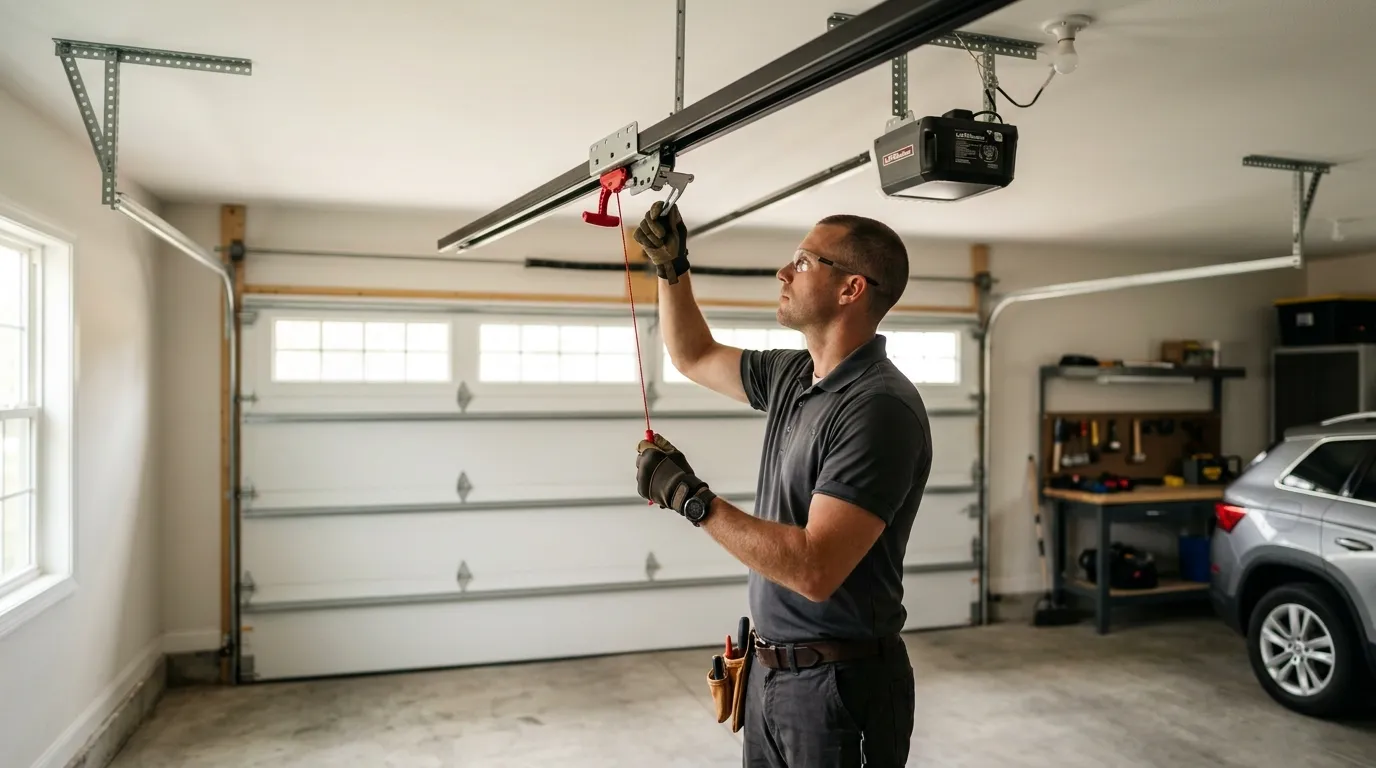
Call or use the site to describe what the opener is doing - not moving, moving the wrong way, making a grinding or clicking noise, or dead with no lights at all. That description matters more than the brand or age of the unit, because it tells us whether we're bringing motor parts, a logic board, or just a sensor bracket.
We ask for the rough age of the house too. In a service area built mostly from the 1950s through the 2000s, a house from the 1970s and a house from the 2000s can have completely different opener generations installed, even if both were replaced units rather than original. That context speeds up the visit.
We don't require you to know the opener's model number or horsepower before we come out - if you can send a photo of the unit on the ceiling, that's plenty. We'll confirm what we find on site before doing any work, and if the fix turns out to be a full opener swap rather than a repair, we'll say so plainly rather than nickel-and-diming a unit that's done.
What You Pay
We don't publish a flat number for opener repair because the range is wide - a sensor realignment or a worn drive gear is a different job than a dead logic board or a full head-unit replacement, and we're not going to quote either one without seeing what's actually on your ceiling. What we can tell you is that we price the visit based on the actual failed part, not a menu rate, and we'll give you the number before we start any repair, not after.
One honest limitation: if your opener is old enough that replacement parts are back-ordered or discontinued for that specific model, repair isn't always the cheaper option once you account for the wait. In those cases we'll tell you straight that a new opener costs less in total than chasing a part for a unit that's already near the end of its service life.
What Causes It Around Here
Cold is the biggest factor we see across this service area's climate band. Grease inside an opener's gearbox and on the rail thickens in low temperatures, which makes the motor work harder to start the same door - that extra strain is what burns out gears and drive belts years earlier than it would in a mild climate. It's also why openers here tend to get noisier before they fail outright: the sound is the motor straining against stiff grease, not just age.
The other factor is simply the age curve of the houses themselves. With most of the area's stock dating from the 1960s through the 2005 build-out, a lot of openers now in service are second- or third-generation units on original track and rail hardware from a house built decades earlier. Mismatched generations - a newer opener bolted to older rail geometry - is a common source of the reversing and misalignment complaints we get, and it's not something a universal remote or a quick sensor wipe fixes.
We can't point to a single neighborhood pattern here since housing age varies house to house even on the same block, but the cold-and-age combination holds across the service area generally.
Talk to a Technician Before You Book
Describe what the door is doing and get a straight answer on what it likely needs.
Jobs Like Yours
Recent work from this service line.
Why Bloomington Calls Us
Frequently Asked Questions
Why does my opener work fine in summer but act up in winter?
Grease inside the gearbox and on the drive rail stiffens in cold weather, and that adds resistance the motor has to push through every time it runs. In this climate band that extra strain is a common reason openers that seemed fine in July start grinding, reversing, or stalling once temperatures drop.
Do you repair openers or just replace them?
We repair when the part that failed is available and the unit is otherwise sound - a bad sensor, a worn gear, a failed capacitor. If the model is old enough that parts are back-ordered or discontinued, we'll tell you that up front and let you decide, rather than defaulting straight to a full replacement quote.
My remote works up close but not from the driveway. Is that the opener?
Sometimes, but often it's the antenna on the head unit or interference from something else on the same frequency. We check the easy causes first before assuming the logic board or receiver needs replacing - it's a cheaper fix if that's all it is.
How old does an opener have to be before repair isn't worth it?
There's no fixed year cutoff - it depends on whether the manufacturer still stocks parts for that model. Given the age range of homes in this service area, we run into plenty of openers old enough that a straight swap ends up cheaper than waiting on a discontinued part.
Need Garage Door Opener Repair, Bloomington MN?
Call now for straight answers on cost and timing.